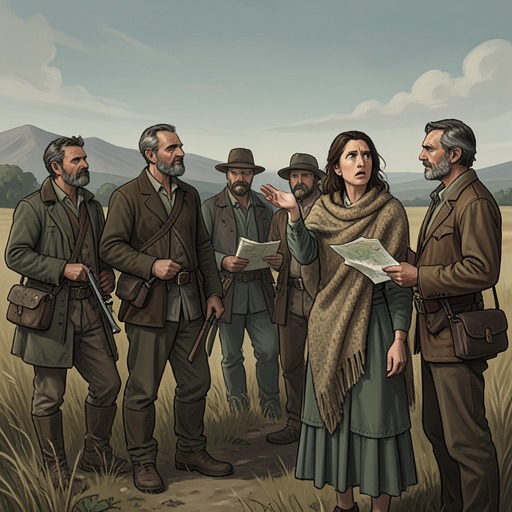
Karl Oscar applied for an immigrant certificate to Brusandell
The EmigrantsKarl Oskar Nilsson’s request to Dean Brusander for parish papers makes his emigration from Ljuder Parish both an announced choice and an administratively recorded break with home. The encounter brings private hardship into the parish’s official record: Karl Oskar names his debts and inability to improve his prospects, withstands the dean’s attempt to keep him, and leaves with the document he needs. The final exchange is more than permission granted; it is a parting blessing that becomes the first mark in a register soon to be filled with departures for North America.
The decision behind the request
By the time Karl Oskar approaches Dean Brusander, emigration has become a practical response to a future he cannot accept. He and Kristina have lived at Korpamoen for four years and are several hundred riksdaler poorer than when they began. Their labor has not improved their position; remaining means continuing until strength is spent, with only the reserved room and its meager bread awaiting them in old age. The family’s mounting financial pressure gives the request its urgency: this is not a speculative journey undertaken from comfort, but a departure from a farm that has failed to provide security despite years of work.
Kristina’s doubts have sharpened what is at stake. Karl Oskar sees possibility in accounts of North America, but she cannot treat rumor and printed descriptions as guarantees. No one they know has crossed the ocean; no land deed or written promise awaits them, and no reliable eyewitness can assure them what they will find. Their disagreement exposes the uncertainty beneath the migration plan: the same destination that represents an escape from hardship to Karl Oskar remains an unverified wager to Kristina. Nonetheless, the household proceeds toward departure, and Karl Oskar’s request makes that choice legible to the community and its institutions.
An official request, not a clandestine exit
The legal setting gives the errand particular significance. A person of good character could leave without petitioning the King, and an extract from the parish register was not strictly required. Robert, an escaped servant, could not safely approach the dean for papers. Karl Oskar chooses differently: he does not want to leave as though he had done wrong. He intends to separate openly from the parish and therefore goes to its dean to ask for the record of himself and his household, explaining that they mean to emigrate to North America.
That distinction links the request to the group’s varied circumstances. The emigrants from Ljuder share dissatisfaction with conditions at home, but their reasons include crop failure, religious persecution, dissent, personal trouble, social exclusion, and unfair employment practices. Some, like Robert, face constraints that make formal departure more difficult; Karl Oskar can appear before the dean and ask for his papers directly. His errand thus expresses both a personal preference for an acknowledged departure and a practical difference between his situation and that of a fugitive from service.
The dean’s challenge
Brusander receives Karl Oskar as a trusted and devout parishioner, not as a stranger whose character is already suspect. That standing makes the dean’s question pointed: why would a diligent farmer, unable to make a living at home, abandon the parish for another continent? He touches Karl Oskar’s shoulder and presses him to consider the adventure he is undertaking with wife and children, asking whether he knows the truth about the land that attracts him. The issue is not merely whether a passage can be arranged; the dean asks whether Karl Oskar can justify exposing his household to an unknown future.
Brusander answers his own challenge with a hostile account of North America. He depicts it as a refuge for rebels, lawbreakers, religious dissenters, and others who have fled authority or punishment in Europe. His argument turns the proposed destination into a moral danger: a place populated by people who reject the order of their home communities. The contrast is sharp. Karl Oskar’s immediate explanation is hardship and debt; the dean interprets departure through obedience, religious discipline, and the supposed character of the emigrants.
The confrontation echoes Brusander’s earlier conflict with Danjel Andreasson over unauthorized preaching. There the dean asserted that church law required a minister to be called and ordained, warned of civil penalties and possible exile, and demanded that Danjel stop his religious work. Karl Oskar is not in the same dispute, but the earlier encounter helps define the authority he now faces: the dean speaks not only as the keeper of parish records but as a spiritual superior who expects counsel to shape conduct. For this request, however, Brusander’s warnings cannot reverse a decision already made.
A choice the dean cannot undo
Karl Oskar mostly keeps silent while Brusander argues. He fumbles with his cap and feels that any answer could be turned against him; he also recognizes that no further persuasion will alter his mind. His silence is not evidence of indecision. When he finally speaks, the decisive fact is that he has already sold out and is free of obligations. The farm has passed beyond the point at which a pastoral warning can preserve the household’s old life. He asks whether the errand can now be attended to.
That announcement changes the balance of the meeting. Brusander regards Karl Oskar as outwardly tractable but stubborn beneath the surface; the farmer’s brief replies and persistent silence have not yielded to repeated advice. The dean concludes that he has done his duty as pastor and teacher. He had expected the desire to emigrate among the peasantry to fade, but Karl Oskar’s completed sale makes that expectation irrelevant to this family. The paper will document a departure that persuasion has failed to prevent.
The paper, the blessing, and the register
Brusander grants the request. As his quill scratches across the paper, Karl Oskar steps back to leave him undisturbed; then the dean turns and hands over the extract from the parish register. The document is the tangible result of the errand, but the exchange does not end in administrative formality. Brusander recalls baptizing Karl Oskar, preparing him for Communion, and baptizing his children. He then prays for God to bless the family during its voyage and hopes they will never regret their bold decision. His blessing acknowledges a bond the departure will sever geographically, even as the parish record makes the separation official.
Karl Oskar bows and thanks him. At the dean’s invitation, he receives a final blessing in the manner of their forebears at parting, and bows more deeply than before: it is the last time he will bow to his parish pastor. The gesture gives the scene its double character. Karl Oskar leaves without retracting his choice, but neither does he turn the parting into a simple act of defiance. The dean has opposed the move and still sends him away under a blessing.
Brusander records that Karl Oskar Nilsson of Korpamoen requested extracts for himself and his household for emigration to North America on March 28, 1850. The date and wording make this more than a private farewell: the parish register preserves the moment when one household’s intention becomes an official departure. Its blank pages will later fill, page after page, with the repeated notation that parishioners have moved to North America. What begins as Karl Oskar’s individual errand therefore anticipates a collective migration. The first entry does not end the story at home; it establishes the pattern through which the departures of his followers will be recorded.